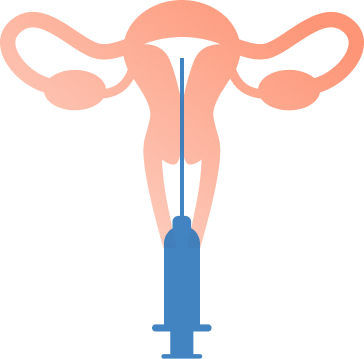
Intrauterine Insemination (IUI) is a fertility treatment that places specially prepared sperm directly into the uterus around the time of ovulation. By helping sperm reach the egg more efficiently, IUI can improve the chances of conception for some individuals and couples experiencing fertility challenges.
At The Bridge Fertility, IUI is often recommended as an early fertility treatment option because it is less invasive than IVF and can be an effective solution for certain fertility conditions.
IUI, or Intrauterine Insemination, is a fertility treatment designed to increase the likelihood of fertilisation by placing concentrated sperm directly into the uterus.
The procedure is carefully timed to coincide with ovulation, allowing sperm to be closer to the egg when it is released. This reduces the distance sperm must travel and helps overcome some of the barriers that can make conception more difficult.
IUI may be performed using a partner’s sperm or donor sperm, depending on your individual circumstances and treatment plan.
IUI can be an effective treatment for a variety of fertility situations. Your fertility specialist may recommend IUI if you are experiencing:
Unexplained infertility
Mild male factor infertility
Ovulation-related fertility challenges
Difficulties with sperm reaching the egg
Fertility challenges related to cervical mucus
The need for donor sperm
Same-sex family building
Solo parenthood using donor sperm
Not everyone is a candidate for IUI. Before treatment begins, your fertility specialist will review your fertility assessment results to determine whether IUI is an appropriate option.
How IUI Supports Fertility Treatment
01
Carefully Timed Treatment
IUI is coordinated with ovulation to maximise the opportunity for fertilisation. In some cases, fertility medications may be used to encourage ovulation and improve treatment outcomes.
02
Sperm Preparation
Before insemination, the sperm sample is processed in a laboratory. This preparation helps concentrate healthy, motile sperm while removing components that are not needed for fertilisation.
03
A Simple Procedure
The prepared sperm is inserted directly into the uterus using a thin catheter. The procedure is usually completed within a few minutes and does not typically require anaesthesia.
04
A Step Before IVF
For some patients, IUI may be recommended before considering more advanced fertility treatments such as IVF. It can provide an effective treatment option while remaining less invasive and less complex.
Understanding Your Chances of Success
The success of IUI depends on several factors, including age, fertility diagnosis, sperm quality, ovulation patterns, and overall reproductive health. While IUI can improve the chances of conception for many individuals and couples, success is not guaranteed. Some patients achieve pregnancy after one cycle, while others may require multiple treatment cycles or alternative fertility treatments. Your fertility specialist can discuss the factors that may influence your individual treatment outcomes and help determine the most appropriate approach for your situation.
Risks and Considerations
IUI is generally considered a safe and low-risk fertility treatment. Potential considerations include:
Mild cramping during or shortly after the procedure
Light spotting following treatment
Side effects from fertility medications when used
A higher chance of multiple pregnancy when ovulation-inducing medications are part of treatment
Your fertility team will explain any potential risks and answer any questions before treatment begins.
IUI can be an effective and less invasive fertility treatment for many individuals and couples looking to improve their chances of conception. Whether you are beginning fertility treatment or exploring your available options, our team is here to provide personalised guidance and support. Contact The Bridge Fertility today to learn more about IUI and schedule a consultation with our fertility team.
Intrauterine Insemination (IUI)
Intrauterine insemination (IUI) is the process of placing prepared sperm directly into the female uterus at the correct time of the menstrual cycle to try to achieve a pregnancy.
IUI is the process of placing prepared sperm directly into the female uterus at the correct time of the menstrual cycle to try to achieve a pregnancy. It is important to note that the fallopian tubes must be open for the treatment to work and therefore IUI can be successful if no other fertility issues have been identified. This treatment may be recommended to heterosexual patients who have been trying to conceive for some time but do not want to have IVF or those who have difficulties with sexual intercourse. It might also be beneficial where there is a mild sperm issue, as the sperm preparation steps help to isolate the healthiest sperm for insemination. It might also be recommended to women with ovulation issues.
IUI treatment with donor sperm can be offered to various patient groups. It may be required by couples for whom the male partner has no sperm present in the ejaculate or who carry a genetic or other condition that may be transmissible. It may also be required by single women or those in female same-sex relationships.
How does IUI work?
The patient receiving treatment will be scanned at scheduled points in their menstrual cycle to determine the optimal time to perform the IUI. This may involve taking medication and/ or an injection, or the IUI may be done in a natural cycle using no medication, depending on the patient and their medical history. On the day of insemination, the patient’s partner will produce a sperm sample which is then analysed under the microscope and prepared for treatment.
If the sample has been previously frozen, such as when using donor sperm, this will be thawed and prepared in a similar way. At the time of insemination, the patient will have a speculum inserted into the vagina to clearly visualise the cervix. A fine catheter will then be passed through the cervix, and the prepared sperm will be pushed through the catheter into the womb.
A pregnancy test is taken two weeks after the procedure. If the test is positive, a scan will be arranged two weeks later to determine the viability of the pregnancy. If it is negative, the patient will be advised to stop the medication, and a period will occur.
Why is IUI important?
Why is IUI important?
When is IUI recommended?
Intrauterine insemination (IUI) is a fertility treatment in which sperm is placed directly into a woman’s uterus to increase the chances of fertilisation and subsequent pregnancy. IUI is often recommended as a less invasive option than IVF/ICSI, as well as in the following scenarios:
Unexplained Infertility
Male Factor Infertility
Difficulties with intercourse
Cervical issues
Ovulation issues
Mild Edometriosis
Donor Sperm
Same sex female couples
Single women
How successful is IUI?
At Bridge Clinic London we pride ourselves in having a multidisciplinary team that is committed to helping you achieve your dreams of starting a family. We will give you all the support that you need at every stage of your journey. The treatment you receive will always be designed around your individual needs.
The chances of success very much depend on the age of the woman at the time of treatment. It is important to remember that success rates can have their limitations when you compare them with your own experience or diagnosis.
Most patients experience little to no pain during IUI. Some individuals may notice mild cramping or discomfort similar to a cervical screening test.
How long does an IUI procedure take?
The insemination procedure itself usually takes only a few minutes, although your appointment may be longer to allow for preparation and monitoring.
How many IUI cycles will I need?
The number of cycles varies depending on your fertility history and treatment goals. Some patients achieve pregnancy within the first few cycles, while others may require additional treatment.
What is the difference between IUI and IVF?
IUI places sperm directly into the uterus to increase the chances of natural fertilisation. IVF involves fertilisation occurring in a laboratory before an embryo is transferred into the uterus.