How Does Intracytoplasmic Sperm Injection Work
How Does Intracytoplasmic Sperm Injection Work in IVF Treatment?
Intracytoplasmic Sperm Injection is a specialized laboratory technique used as part of IVF treatment to help achieve fertilization when there are challenges with sperm quality, sperm count, or previous fertilization outcomes.
Many patients first hear about this procedure during fertility investigations and feel unsure about what it actually means. The name itself can feel overwhelming, but the concept is more straightforward than it sounds.
In simple terms, this technique involves selecting a single sperm and injecting it directly into an egg in a laboratory. This helps bypass natural barriers that may prevent fertilization from occurring on its own.
For many patients, this method is recommended after careful testing shows that standard IVF may not be sufficient.
At Bridge Fertility London, this procedure is only recommended when clinically appropriate, based on individual test results and fertility history. The focus is always on clarity, safety, and evidence-based decision-making.
Quick answer:
This procedure works by injecting a single sperm directly into a mature egg in a laboratory setting during IVF. It is used to assist fertilization when natural sperm-egg interaction is unlikely to succeed.
Key takeaways:
- It is a laboratory-based fertilization technique used in IVF
- A single sperm is injected directly into an egg
- It is commonly used for male factor infertility or previous IVF fertilization issues
- It helps increase fertilization chances but does not guarantee pregnancy
- It is performed by trained embryologists in a controlled lab environment
Why This Technique Is Used in IVF Treatment
IVF is designed to help fertilization happen outside the body. In standard IVF, eggs and sperm are placed together in a laboratory dish and allowed to interact naturally.
However, in some cases, sperm may not be able to fertilize the egg effectively. This can be due to:
- Low sperm count
- Poor sperm movement
- Abnormal sperm shape
- Previous failed fertilization during IVF
- Surgically retrieved sperm
- Unexplained infertility after testing
When these challenges are present, embryologists may recommend a more precise method of fertilization.
This is where direct sperm injection into the egg becomes helpful. It removes the uncertainty of natural sperm penetration and allows fertilization to occur under controlled laboratory conditions.
Step-by-Step Process of Intracytoplasmic Sperm Injection
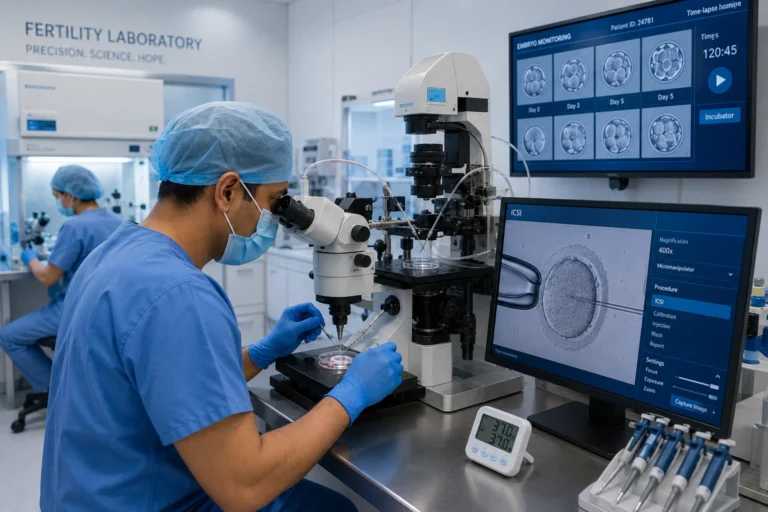
The process takes place in a highly controlled laboratory environment and is performed by trained embryologists using advanced microscopes and equipment.
Step 1: Ovarian stimulation and egg collection
Hormonal medication is used to stimulate the ovaries to produce multiple eggs. Once ready, eggs are collected through a minor procedure.
Step 2: Sperm collection or retrieval
A sperm sample is provided or surgically retrieved if necessary. The sample is prepared in the laboratory.
Step 3: Sperm evaluation and selection
Embryologists examine sperm under a microscope and select a single healthy sperm based on movement and structure.
Step 4: Microinjection into the egg
Using a fine glass needle, the selected sperm is carefully injected into the center of a mature egg.
Step 5: Fertilization monitoring
The egg is observed to see if fertilization occurs. This is typically assessed the following day.
Step 6: Embryo development
If fertilization is successful, the embryo is monitored over several days as it develops.
Step 7: Embryo transfer or freezing
Healthy embryos may be transferred into the uterus or frozen for future use.
Each step is carefully timed and monitored to maximize safety and success.
What Happens Inside the Laboratory
The laboratory is one of the most important parts of IVF treatment. It is where fertilization and early embryo development take place.
Inside the lab:
- Temperature and air quality are strictly controlled
- Embryologists use high-powered microscopes
- Eggs and sperm are handled with extreme precision
- Development is monitored continuously
Even though patients do not see this process directly, it is highly structured and closely supervised.
The goal is to replicate natural conditions as closely as possible while improving the chances of fertilization when needed.
Who May Need This Type of Fertilization Method
This technique is not used for every IVF patient. It is recommended based on specific medical findings.
You may be advised to consider it if:
- Sperm count is significantly low
- Sperm movement is reduced
- There are abnormalities in sperm shape or function
- Previous IVF cycles had no fertilization
- Frozen or surgically retrieved sperm is used
- Fertility issues remain unexplained after testing
In some cases, it may also be used proactively if the specialist believes fertilization may be difficult.
How It Differs From Standard IVF
Understanding the difference between IVF and this technique helps clarify why it is used.
Standard IVF
- Eggs and sperm are placed together in a dish
- Fertilization happens naturally
- Sperm must penetrate the egg on its own
Sperm injection method
- A single sperm is selected
- Sperm is directly injected into the egg
- Fertilization does not rely on natural penetration
The second method provides more control and is often used when natural fertilization is uncertain.
Emotional Experience of Starting Treatment
Hearing that a more advanced fertility technique is needed can feel emotional for many patients.
You may feel:
- Relief that there is a solution
- Anxiety about laboratory procedures
- Confusion about why it is needed
- Hope for improved fertilization chances
These emotions are completely normal. Fertility treatment often brings both hope and uncertainty at the same time.
A supportive clinic will take time to explain every step in simple language so you feel informed rather than overwhelmed.
Does the Procedure Hurt the Patient
The procedure itself does not cause pain because it takes place entirely in a laboratory.
However, it is part of a broader IVF cycle, which may include:
- Hormonal injections
- Egg retrieval procedure
- Mild cramping or bloating
These effects are usually temporary and managed with medical guidance.
Patients do not experience the sperm injection process directly.
Success Rates and What Affects Outcomes
This technique improves fertilization chances but does not guarantee pregnancy.
Success depends on several factors:
- Age of the egg provider
- Egg quality
- Sperm quality
- Embryo development
- Uterine health
The procedure mainly improves the fertilization step. After fertilization, natural biological processes still determine embryo development and implantation.
Some patients achieve success in the first cycle, while others may require multiple attempts.
Risks and Limitations
Although widely used, it is important to understand its limitations.
Limitations include:
- Not all injected eggs will fertilize
- Not all embryos will develop normally
- Pregnancy is not guaranteed
- Underlying fertility issues may still affect outcomes
Rare considerations:
- Slightly increased need for genetic counseling in certain cases
- Careful evaluation of underlying sperm conditions
Your specialist will always explain whether this approach is appropriate for you.
Role of Embryologists in the Process
Embryologists play a central role in this treatment. They are highly trained specialists who manage fertilization in the laboratory.
Their responsibilities include:
- Selecting healthy sperm
- Injecting sperm into eggs
- Monitoring fertilization
- Observing embryo development
- Supporting decisions about transfer or freezing
Their expertise is essential for maintaining accuracy and safety throughout the process.
What Happens After Fertilization
Once fertilization occurs, embryos are closely monitored for several days.
Embryologists observe:
- Cell division patterns
- Growth rate
- Structural development
Depending on progress, embryos may be:
- Transferred into the uterus
- Frozen for future use
- Tested genetically if needed
Each decision is based on medical suitability and patient preferences.
How Clinics Decide If This Method Is Needed
The decision is made based on diagnostic results and clinical judgment.
Your doctor will consider:
- Semen analysis results
- Hormone levels
- Previous IVF outcomes
- Fertility history
- Overall reproductive health
The goal is to choose the method that gives the best chance of fertilization while maintaining safety.
Lifestyle and Preparation Before Treatment
While the procedure happens in the lab, overall fertility health still matters.
Patients are often advised to:
- Eat a balanced diet
- Reduce alcohol intake
- Avoid smoking
- Maintain a healthy weight
- Manage stress levels
These steps support general reproductive health and treatment readiness.
Myths and Misunderstandings
There are several common misconceptions about this treatment.
Myth: It guarantees pregnancy
This is not true. It only assists fertilization.
Myth: It is only for severe infertility
It is also used for specific sperm-related issues or previous IVF challenges.
Myth: It affects natural fertility permanently
It does not impact natural fertility in the future.
Cost Considerations
This procedure may increase IVF costs due to the additional laboratory work involved.
Costs depend on:
- Number of eggs retrieved
- Clinic pricing structure
- Laboratory requirements
Clinics should always provide clear cost explanations before treatment begins.
How It Fits Into IVF Treatment Planning
This method is one step within a larger IVF cycle.
A typical cycle includes:
- Ovarian stimulation
- Egg retrieval
- Fertilization in the lab
- Embryo development
- Embryo transfer or freezing
Each stage is carefully coordinated to support the best possible outcome.
Fertility Clinic Support and Communication
Good communication is essential during fertility treatment.
You should expect:
- Clear explanations of each stage
- Regular updates on embryo development
- Time to ask questions
- Emotional reassurance when needed
At Bridge Fertility London, care is designed to keep patients informed and supported throughout every stage of treatment.
Conclusion: Understanding the Process Clearly
This laboratory fertilization technique is a precise and carefully controlled method used during IVF to assist fertilization when natural sperm-egg interaction is unlikely to succeed.
While it does not guarantee pregnancy, it can significantly improve fertilization outcomes in selected cases.
Understanding how it works can help reduce uncertainty and support more confident decision-making during fertility treatment.
Bridge Fertility London provides compassionate, evidence-based care focused on clarity, transparency, and individualized treatment planning.
FAQs
What is the main purpose of this fertilization technique
The main purpose is to help achieve fertilization by directly injecting sperm into an egg. It is used when natural fertilization may be difficult due to sperm-related issues or previous IVF outcomes. It helps increase fertilization chances in specific cases.
Is this procedure safe?
Yes, it is considered a safe and widely used laboratory technique in fertility treatment. It has been used for many years in IVF clinics around the world. Most pregnancies resulting from this method are healthy.
Does it increase chances of pregnancy?
It increases the chance of fertilization, but not necessarily pregnancy. Pregnancy also depends on embryo quality and uterine conditions. It is one step in a multi-stage process.
Is the procedure painful?
No, the procedure itself is not painful because it is done in a laboratory. Patients only experience the IVF-related parts such as injections or egg retrieval. The fertilization step is not felt by the patient.
How long does the process take
The fertilization process takes place within a few days after egg retrieval. The full IVF cycle, including preparation and embryo transfer, usually takes several weeks.
Gentle Next Step
If you are learning about this treatment, you may be exploring your fertility options or preparing for IVF. It is completely normal to have questions at this stage.
At Bridge Fertility London, our approach is centered on clarity, care, and evidence-based guidance. We take time to explain every step so you understand your options without pressure or confusion.
If you are ready, booking a consultation can help you understand whether this treatment is part of your personalized fertility plan and what your next steps could look like.
Follow us on our social media channels below:
Explore our related articles below: